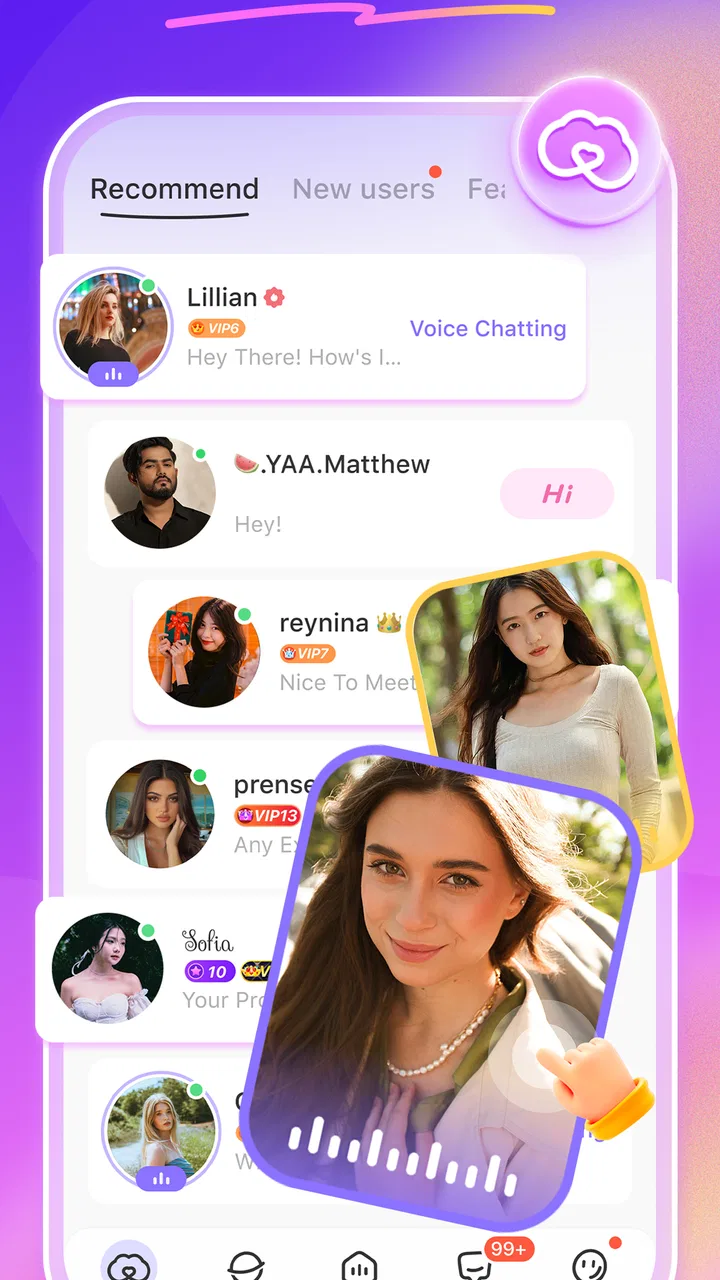
SUGO:Voice Chat Party
- 3.2
- Rating
- 50.00M
- Installs
- Free
- Price

 Analysis by App-foxy
I tried SUGO: Voice Chat Party as a social app built around live conversation rather than carefully edited posts. Its basic appeal is easy to understand: open the app when you want to hear another person’s voice, join a more immediate exchange, or make contact beyond your usual circle. That makes it feel different from a conventional social feed, where communication is often delayed, public, and shaped by photos or short text.
My overall impression is mixed but useful. SUGO can make socializing feel more spontaneous, especially when I have little interest in typing long messages. At the same time, that immediacy changes the cost of attention. A voice room can pull me into a conversation faster than I expected, and the worldwide audience means I need to be more deliberate about who I engage with and how long I stay. I would recommend it to adults who enjoy casual voice interaction, but not to anyone looking for a quiet, tightly controlled messaging tool.
Why SUGO feels different from ordinary social apps
The app belongs to the social category and is developed by IndiaMasterApp. It is free to install, which makes trying it straightforward, although optional in-app purchases range from $0.49 to $99.99 per item. Its audience is mature, with a 17+ content rating, so I would not treat it as a general family chat app or hand it to a younger user without careful supervision.
You May Also Like

 AccuWeather: Weather Radar
AccuWeather Review: A Quick, Clear Forecast for Everyday Decisions
For everyday plans, the best forecast is the one you can understand quickly. AccuWeather makes rain timing, radar, and local conditions easy to act on, with a few trade-offs.

 Hill Climb Racing
Why Hill Climb Racing Still Turns Crashes Into One More Run
A tiny car, a bumpy hill and one more upgrade: Hill Climb Racing keeps resurfacing because its simple chaos makes every near-miss feel personal.

 AliExpress - Shopping App
AliExpress Makes Global Shopping Feel Personal, but Shoppers Bear the Risk
AliExpress turns a global marketplace into a pocket-sized discovery engine. Its reach is useful, its shopping loop compelling, and its trade-offs easy to miss.

 Lords Mobile: Kingdom Wars
Lords Mobile Is a Kingdom-Building Routine, Not a Quick Match
A case-by-case verdict on the building, battles, device demands, and social commitments that make Lords Mobile rewarding for some players and exhausting for others.

 PDF Scanner app - TapScanner
TapScanner Makes Paperwork Easier to Capture, Check, and Share
TapScanner makes scanning with a phone feel less like a rescue operation and more like a dependable step in getting work done. Its capture tools are useful, though not flawless.

 Block Blast!
 Shows How Much a Puzzle Game Can Leave Out
A quiet grid game shows why puzzle players increasingly value instant clarity, repeatable skill and low-pressure play—and where the genre still needs to catch up.
More From Our News Desk
View All News


What stands out is the shift from composing a message to entering a moment. In a normal messenger, I can pause, edit, and decide exactly when to send. In a voice-centered environment, the rhythm is less polished. I have to listen, respond, and interpret tone as the exchange happens. That can feel warmer than text, but it also leaves less room to hide uncertainty or recover from an awkward pause.
This is where SUGO may meet a real everyday need. Someone who works remotely, studies away from home, travels, or simply wants light social contact may find a short voice conversation more satisfying than scrolling. I can imagine opening it after dinner, joining a room for a few minutes, and getting the feeling of company without arranging a formal call with a friend.
That same convenience is also the first trade-off. The app encourages availability, while many people need stronger limits around their time. If I open it with no plan, I can move from one conversation to another without noticing how much attention has passed. For me, the best experience comes from treating it as a deliberate social break rather than leaving it open in the background all evening.
How conversations actually change pace
Voice communication removes several layers that normally slow social contact down. There is no need to create a perfect caption, choose a flattering image, or wait for someone to understand a short text. A greeting, laugh, or change in tone can carry more meaning than a paragraph. That makes the first few minutes feel lively, particularly when both people are comfortable with informal conversation.
However, spontaneous does not always mean clear. Different accents, noisy surroundings, uneven confidence, and unfamiliar expressions can make a short exchange harder to follow. I found that a simple habit helps: asking one direct clarifying question instead of pretending I understood. That keeps the conversation honest and prevents a vague interaction from becoming frustrating.
SUGO is more suitable for people who enjoy conversational momentum than for users who want carefully organized communication. If I need to exchange an address, plan a meeting, or preserve exact instructions, I would still use text afterward. Voice is excellent for mood and connection, but it is not automatically the best format for details. A practical workflow is to use the live conversation for discussion and another trusted channel for anything important that must be remembered accurately.
Another useful approach is to enter with a small purpose. I might want to meet someone with a similar interest, practice speaking with people from another country, or simply have a brief conversation during a lonely commute. A specific reason makes it easier to judge whether a room is worthwhile. Without one, the worldwide social setting can become a stream of disconnected exchanges that feel exciting for a moment but leave little behind.
The international angle is one of the app’s more interesting qualities. Talking with people from different places can challenge assumptions and make ordinary subjects more engaging. It also requires patience. Humor, personal boundaries, and ideas about politeness are not universal. I would avoid treating a quick misunderstanding as a personal insult and would leave a conversation calmly when the tone no longer feels respectful.
The hidden cost of live attention
Text-based social networks let me check a message and return to my task. Live voice interaction asks for continuous attention. Even when I am not speaking, I am listening for a change in tone, waiting for a turn, and deciding whether to continue. That can be enjoyable, but it is mentally different from browsing a feed.
I would not use SUGO while driving, cycling, cooking over heat, or doing any task that depends on full concentration. The risk is not only missing a sentence. A lively conversation can make me underestimate how distracted I have become. The safest habit is to keep live social use for a place where I can stop what I am doing and focus properly.
Notifications and the possibility of an unexpected conversation can also change the shape of a day. Even if I do not answer every invitation, the awareness that something may be happening can create a small pressure to check. I manage that by deciding in advance when I am available. If I am working, studying, or trying to sleep, I treat the app as closed rather than half-present.
This is an important difference between SUGO and a conventional messaging app. A normal chat often fits around my schedule. A live voice space can ask me to fit around its schedule. Neither approach is automatically better, but they serve different personalities. People who enjoy quick interaction may appreciate the energy. People who guard their focus may find the same energy tiring.
There is also an emotional attention cost. Voice can create a sense of closeness quickly, even when I know very little about the other person. The human sound of conversation may make an interaction feel more personal than a profile or text exchange. I think it is wise to enjoy that warmth without treating immediate familiarity as genuine trust. A pleasant first conversation is a starting point, not proof that someone belongs in my private life.
Boundaries matter more when contact is immediate
Because the app is intended for mature users, I would approach it with adult judgment from the first session. I would not share my home address, workplace details, financial information, private photos, or identifying routines with someone I have just met. That advice is especially important in a worldwide social environment, where I may not understand the other person’s context or intentions.
My preferred boundary is simple: keep early conversations general, stay in the app’s social context, and end the exchange when I feel pressured. I do not need to justify leaving a room or declining a request. A respectful conversation should allow a clear no. If someone pushes for personal contact, money, secrecy, or information that feels too intimate, I would stop engaging instead of trying to negotiate.
Voice also deserves a little more caution than text because it reveals mood and sometimes background details. A careless conversation can expose the names of people nearby, a location clue, or information from a television or work call in the room. I make a habit of checking my surroundings before speaking, using headphones when appropriate, and avoiding conversations in public places where strangers can hear sensitive parts of the exchange.
Paid items deserve the same deliberate approach. Since the app is free but offers purchases, I would not buy anything simply because a conversation creates a moment of excitement or social pressure. I would first decide whether the purchase has a clear personal value, then check the amount carefully. A budget limit is more useful than relying on willpower while caught up in a fast-moving interaction.
I would also explain these boundaries to a friend who is new to live social apps. The most useful rule is not “never talk to strangers”; that is too broad to be practical. My rule is “share trust gradually.” Start with ordinary topics, observe whether the other person respects limits, and keep control of the pace. If the app stops feeling like a voluntary conversation and starts feeling like an obligation, leave.
Who will enjoy it, and who should choose something else
SUGO is a good match for adults who find voice more natural than typing. It may suit someone who wants casual international contact, a quick social diversion, or a way to make conversation feel less formal. It is also appealing to people who dislike the performance pressure of a photo-first network. A voice exchange can place more emphasis on personality and responsiveness than on building a polished public image.
I would be more cautious recommending it to someone who needs strong privacy controls, predictable communication, or a distraction-free routine. If your main goal is reliable contact with family, colleagues, or close friends, a familiar messenger may be better. Those apps usually make it easier to find known people, search past messages, and keep practical information organized. SUGO’s strength is discovery and immediacy, not replacing every form of communication.
It is also not my first choice for users who dislike unplanned interaction. A text service gives me more control over when I reply and how much of myself I reveal. A curated community may be better for someone who wants conversations organized around a specific subject. SUGO makes more sense when the social moment itself is the point.
The app’s public numbers suggest broad reach: it has passed 50 million installs, while its average rating is 3.2 from around 155 thousand ratings. I read that combination as a sign of a widely tried product with an uneven experience rather than a universal recommendation. The volume shows that the concept has attracted a large audience, but the middling average is a reminder that live social interaction can vary greatly from one person and conversation to another.
Its current version is 2.50.0.0, and it supports devices running Android 6.0 or later. Those details make it accessible to many older Android phones, although the quality of any voice-based experience still depends on the device, connection, microphone, and surroundings. I would test it in the place where I expect to use it most instead of assuming that a smooth first session will remain smooth everywhere.
A realistic way to use it without losing the day
My most sensible routine would be a short, planned session. I would open SUGO after finishing work, decide that I have enough time for one or two conversations, and avoid keeping it active while moving between unrelated tasks. I would begin with general topics, pay attention to whether the other person listens as well as speaks, and leave if the exchange becomes repetitive or uncomfortable.
Afterward, I would note whether I actually feel more connected or merely overstimulated. That small check is surprisingly useful. Some sessions can be entertaining but leave me scattered. Others may be brief yet genuinely improve my mood. Measuring the experience by how I feel afterward helps me choose the right time to return instead of confusing constant activity with meaningful social contact.
For a user who wants to practice conversational confidence, I would recommend preparing two or three neutral subjects before entering. This reduces the pressure to invent a topic instantly and makes it easier to leave gracefully when the discussion runs out. It also prevents the common mistake of revealing personal information simply because silence feels uncomfortable.
For someone using the app while traveling, I would keep the purpose narrow. A quick conversation about food, music, language, or daily routines can be enjoyable, but I would not use an unfamiliar social contact as a substitute for trusted local advice. The app can broaden perspective; it should not replace common-sense checks when safety, money, or travel plans are involved.
One final practical distinction helps: use live voice for connection, not documentation. If a conversation produces a plan, agreement, or important piece of information, write it down separately and verify it. That simple separation preserves the warmth of speaking while avoiding the confusion that comes when an informal chat is expected to function like a reliable record.
My verdict on the social experience
After using it, I see SUGO as a lively but demanding social app. It changes communication from something I can prepare and postpone into something that happens in real time. That can break through the distance of text and make a quiet evening feel more social. It can also interrupt concentration, blur personal boundaries, and make a short encounter feel more significant than it really is.
I would recommend it to an adult who understands that the best experience depends on active choices: choose when to open it, choose what to share, choose when to leave, and keep purchases within a firm limit. I would skip it if I wanted a private family messenger, a structured interest community, or a calm app that stays in the background.
The developer, IndiaMasterApp, has created something with a clear social identity, but the app is not frictionless for every user. Its free entry and large international audience make experimentation easy, while the mature rating, optional spending, and unpredictable attention demands call for restraint. In my view, the real value is not in staying connected all day, but in choosing a short conversation that genuinely deserves your attention.
That is why my final recommendation is qualified rather than absolute. SUGO can be worth installing when I want voice-led social discovery and have the time and boundaries to use it intentionally. If I need clarity, privacy, or dependable communication with people I already know, I would choose a more focused alternative. Used on its own terms, though, it offers a direct and sometimes refreshing way to turn an ordinary spare moment into a human conversation.
FAQs for SUGO:Voice Chat Party
01What is SUGO: Voice Chat Party and how does it work?
SUGO: Voice Chat Party is a social networking app focused on real-time voice conversations, group chats, and meeting new people online. After creating a profile, you can browse available rooms or social spaces, join ongoing discussions, and communicate through voice messages or live audio, depending on the feature available in your region. The experience is designed around casual conversations, entertainment, and discovering users with similar interests.
02Is SUGO: Voice Chat Party free to download and use?
SUGO can generally be downloaded for free on compatible Android and iOS devices, and many of its basic social and voice-chat features may be available without payment. However, the app can include optional in-app purchases, virtual items, premium functions, or subscription-style benefits. Before spending money, review the pricing shown in your app store and check the purchase settings, since virtual currencies and gifts may add costs during conversations.
03Does SUGO: Voice Chat Party require a microphone, camera, or personal information?
The app primarily focuses on voice-based interaction, so microphone access may be necessary if you want to participate in live audio rooms or send voice content. Camera access may be requested for profile images, video-related features, or other optional functions, but you should only approve permissions that you are comfortable using. Registration may also require information such as a nickname, age, profile photo, or login details.
04Is SUGO: Voice Chat Party safe for teenagers and younger users?
SUGO is intended for social interaction, which means users may encounter strangers, public conversations, mature topics, or unsolicited messages. Parents and guardians should check the current age rating, privacy policy, community guidelines, and available parental controls before allowing a minor to use the app. Avoid sharing your address, school, passwords, financial information, or private photographs, and report or block anyone who behaves inappropriately.
05What should I do if I encounter harassment, scams, or inappropriate content on SUGO?
If another user sends offensive messages, requests money, pressures you to share private information, or behaves suspiciously, stop communicating and use the app’s block and report tools whenever available. Do not send payments or move the conversation to an unknown external service. Save relevant evidence, such as screenshots or usernames, and contact SUGO support through the official help channel. You can also adjust privacy settings to limit messages and unwanted interactions.
Pros
- Easy to join voice rooms based on shared interests.
- Live conversations feel more spontaneous than text messaging.
- Virtual gifts and reactions make interactions more engaging.
- Users can discover new communities beyond their existing contacts.
- The interface is colorful and generally simple to navigate.
Cons
- Room quality varies widely depending on hosts and participants.
- Some features may require coins or paid virtual gifts.
- Public voice chats can expose users to rude or inappropriate behavior.
- Notifications may become frequent if many rooms are followed.
- Privacy settings should be checked carefully before sharing personal details.

SUGO:Voice Chat Party
Gallery